Europe's gene-editing rules just changed. The hard part was never the editing.
On 17 June 2026 the European Parliament and Council adopted the EU's regulation on New Genomic Techniques (NGTs) for plants. It has been a long road since the original 2023 proposal, and for anyone working in plant breeding or agtech, it matters.
Here's the short version of what changed.
The old rulebook was the GMO directive from 2001. It treated any edited plant as a GMO, full stop. It made no difference whether the edit was the kind of change you could get through ordinary breeding or a natural mutation; the plant still faced the entire authorisation process. Slow, expensive, and for most breeders, not worth attempting.
The new regulation sorts NGT plants into two groups:
- NGT-1 plants carry a limited number of small, targeted edits and no foreign DNA, the sort of change that could in principle arise through conventional breeding. These are now treated like conventionally bred varieties: no GMO authorisation, no labelling beyond seed-level transparency, and no extra checks on their offspring. One caveat worth knowing is that plants engineered for certain traits, such as herbicide tolerance, get bumped into the stricter category regardless.
- NGT-2 plants involve more substantial modifications and stay under the existing GMO regime, with risk assessment and labelling.
The regulation comes into force 20 days after it appears in the EU Official Journal, and most of it applies from mid-2028. That leaves roughly a two-year runway.
Why breeders should care
This is the clarity the sector has been waiting on. A seed company that wants to bring a CRISPR-edited variety to market, say one with better drought tolerance or disease resistance, now has a route that is commercially realistic rather than theoretical. The maths on whether a precision-breeding programme is worth starting has genuinely shifted.
The part people underrate
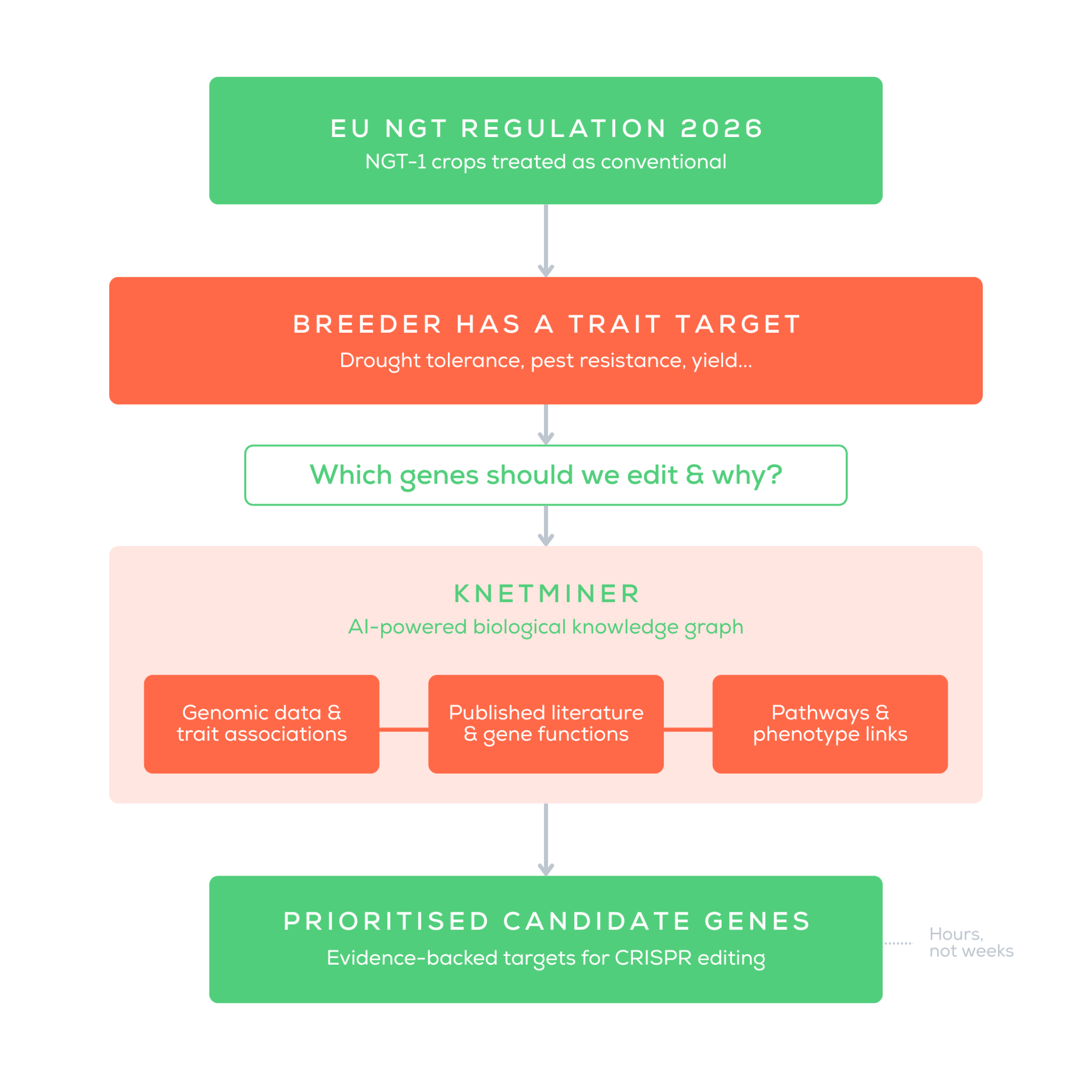
Editing a gene is the easy bit now. Deciding which gene to edit is not.
Every breeding programme hits the same wall early. You have a target trait, and then a sprawling, disconnected pile of genomic data, trait associations, papers, and gene-function evidence to work through before you can even name a sensible candidate. That is weeks of effort, and it is precisely the part that does not get any faster just because the regulation did.
This is the problem KnetMiner was built for. Our platform pulls genes, traits, phenotypes, pathways, and publications into a single biological knowledge graph spanning hundreds of curated datasets. The route from "we want this trait" to "here are the candidate genes, and here's the evidence behind each one" takes hours instead of weeks.
We already work with plant research organisations and commercial breeders across wheat, maize, brassica, tomato, and others. As NGT pipelines spin up across Europe, demand for fast, reproducible gene prioritisation is only heading one way.
What to do with the next two years
The transition period is not downtime. Breeders who use it to stand up NGT-1 pipelines, with solid gene-function intelligence underneath them, will be ready to move the moment the rules apply in 2028. Everyone else will be starting from a target trait and a literature search.
If you are working on NGT programmes and want to see how KnetMiner fits into your candidate-gene workflow, we're happy to talk.
You might also like

.png)
Europe's gene-editing rules just changed. The hard part was never the editing.
.png)
Introducing KnetMiner GenePage: Cross-Reference Any Gene, Powered by Graph Chat

Closing the Gap Between GWAS Peaks and Candidate Genes: Introducing Agentic KnetMiner
.png)
Deeply FAIR Agrigenomics: AgriSchemas, Data Integration, and the EBI GXA RDF Conversion
.png)
.jpg)


Graph Chat: A New Way to Explore and Understand Biological Knowledge Graphs with AI

The Future is Green: How AI in Biotech is Revolutionising Plant Genomics